
To start with, in simple terms:
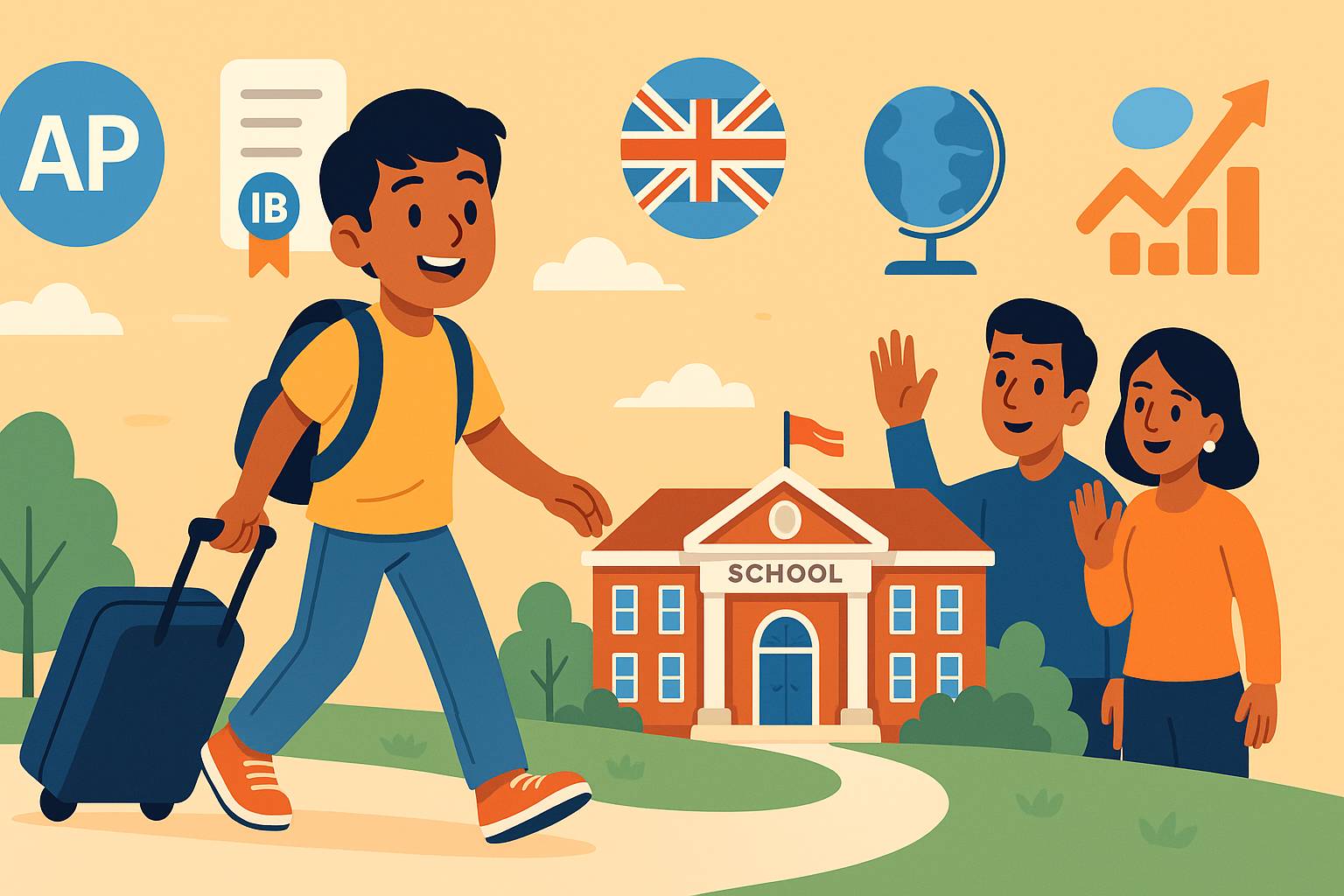
It is possible to send a child to study at a school in the U.S. on their own.
There are schools that prepare students for admission to the top universities in the U.S. (Stanford, Harvard, MIT, Princeton, Columbia). If that is the goal, we (Visakrokit) can prepare him from the very beginning to ensure he is admitted to the university.
The child can live with a host family (most often with a teacher’s family) or in a dormitory. The cost of living is $1,000–$1,500 per month.
Children can be sent abroad starting at ages 10–14, but most are sent between the ages of 14 and 16 (9th–12th grade).
Tuition typically costs $20,000–$50,000 per year; our company, VisaKrokit, negotiates rates with schools for $10,000–$15,000 per year ($1,000–$1,500 per month).
During school breaks, the child can come home to his or her home country; the standard summer break is 3 months, and the winter break for the Christmas holidays is 1–2 weeks.
The school requires a basic level of English for admission, but if you don’t have it, you can take English language courses at the beginning.
In one year of study, a child will learn English from scratch and speak it fluently, whereas if they took classes in our countries, it would take 10+ years.
We recommend sending your child to major cities like Los Angeles or nearby cities because the weather is ideal, there are no natural disasters (tornadoes, floods, etc.), and most importantly, your child will make influential friends, since in the U.S.—just like in our countries—it’s common practice to hire friends or classmates.
You can even enroll in school in the fall.
Visakrokit will handle the entire visa process for a service fee of $970 plus government fees.
Visakrokit Contact Information (representative in the U.S.):
WhatsApp +77007481976
Telegram +16266821817
Why Do Parents Send Their Children to Study in the U.S.?
Abroad, high school education is often viewed as a “long run-up” to a successful career: the AP and IB academic tracks (additional courses in high school), an English-language environment, a well-designed support system, and a low-stress (compared to the EGE/ENT) assessment model all contribute to a portfolio that improves a student’s chances of getting into a top university, strengthens “global” skills, and entitles graduates to work in the U.S. for up to three years after completing their bachelor’s degree. (files.eric.ed.gov, OECD)
1. The Path to a Top University
- IB graduates are admitted to Ivy League schools 18% more often than the average applicant; the difference compared to the rest of the top 25 U.S. colleges reaches 22%.
- Admissions committees “look at the rigor of the curriculum”: taking 6–10 AP or Honors courses statistically increases the likelihood of admission to selective colleges. (files.eric.ed.gov)
2. A More Well-Rounded Education
- AP and IB DP provide access to more than 40 college-level courses and 6 comprehensive IB modules, which teach students research skills and self-management. (files.eric.ed.gov)
- Curricula are supplemented with arts, sports, and STEM clubs; schools publish schedules for tutoring sessions and wellness centers specifically for international students. (files.eric.ed.gov)
3. A degree that is recognized worldwide
- IB transcripts are sent annually to more than 4,500 universities in 110 countries, and IB DP graduates apply to an additional 5,000 institutions of higher education.
- Credit transfer for AP exams (scores of 4–5) can shorten college studies by one semester or one year. (files.eric.ed.gov)
4. Long-Term Career and Income
- In the U.S., the median earnings of professionals with a bachelor’s degree are 65% higher than those of high school graduates.
- Proficiency in English alone increases income: immigrants who are fluent in English earn 15–25% more than their colleagues with limited English proficiency. (dalspace.library.dal.ca)
5. English as a “Second Native Language”
Daily classes and campus interactions provide 5–7 times more hours of real-world practice than language courses in one’s home country, which quickly brings students up to the academic level required for the TOEFL or IELTS. (files.eric.ed.gov)
6. “Global Competence”
The OECD considers the ability to work in multicultural teams to be a key skill of the 21st century; international classes and project groups at boarding schools naturally foster this competency. (OECD, Frontiers)
7. Quality of the School Environment and Support
- Boarding campuses offer 24/7 supervision, as well as academic and mental health counselors; research shows that such an environment has a positive impact on academic motivation and social skills.
- For international students, a dedicated ESL center (English language instruction), mentors, and a “parent portal” are available so that families can remotely monitor their children’s progress. (files.eric.ed.gov)
8. Personal Development
Living independently, following a structured schedule, and serving as “seniors” in the dorm foster responsibility, leadership, and time management—qualities highly valued by employers.
9. An Alternative to High-Stress Exams at Home
Russia’s Unified State Exam (EGE) and Kazakhstan’s Unified National Test (ENT) are highly stressful exams: a 10% increase in cortisol during the week of the test leads to a 0.4 σ drop in scores. (NBER, ScienceDirect)
American schools assess progress cumulatively, which reduces pressure and allows for broader talent development than the “race for test scores.” (files.eric.ed.gov)
10. Future Mobility: Education → Work → Immigration
- After completing their bachelor’s degree, international graduates are eligible for OPT: 12 months of work in their field of study, plus an additional 24 months for STEM fields (for a total of 36 months). (USCIS)
- During this time, the employer can file for an H-1B work visa or directly for an EB-2/EB-2 NIW green card; for those with exceptional scientific talent, the EB-1 pathway is available. (USCIS)
Conclusion
The U.S. offers not just “education in English,” but a comprehensive ecosystem: a strong academic foundation, a vibrant student life, globally recognized degrees, and a clear pathway from high school to college, a career, and—if desired—immigration. It is precisely this “combination effect” that makes American schools an attractive choice for parents from the CIS.
Income of Foreign Graduates of U.S. Universities.
International graduates of top U.S. universities start their careers with a base salary ≈ $85,000–$130,000 per year (excluding bonuses) and quickly catch up with their local colleagues: the median salary for new H-1B professionals is — $94,000, and by the middle of their careers, the median for those same universities rises to $180,000–$200,000. Software engineers ($102,000) and analysts in finance/consulting ($110,000–$130,000) receive the highest starting salaries, while humanities graduates start at $70,000–$90,000. The prestige of master’s degrees (MBA, STEM-MS) adds approximately 40–70% to the base salary. Below are specific figures for MIT, Harvard, Yale, Columbia, the Ivy League average, and official USCIS statistics on H-1B visas.
1. Entry-level positions after earning a bachelor’s degree (0–3 years of experience)
| University (Class of 2024) | Average/Median Starting Salary | Typical Majors |
| MIT | $126,438 average base salary (MIT Admissions) | 45% — Tech/Engineering, 22% — Finance |
| Harvard College | $110–120k for 50% of consultants; > $130k for 28% of finance professionals (features.thecrimson.com) | Consulting, Finance, Tech |
| Yale College | $90,097 on average; 42% earn ≥ $100k (Yale Career Strategy, Yale CDN) | Finance 49%, Tech 25% among those earning “100k+” |
| Columbia College/Engineering | $85,000 average starting salary (Columbia Career Services) | Finance, Consulting, Media |
| Ivy League (on average) | $86,025 median after 3 years of work | — |
| Bachelor’s Degree in Computer Science (according to NACE) | $102,033 average starting salary (Careers and Development | MIT) | Software Development, Data Science |
What does this mean for a foreigner?
- Employers pay the same “salary scale” as they do for American graduates; there is almost no difference in the starting salary.
- Visa status is taken into account when making an offer, but according to MIT CAPD, 60% of international graduates accept an offer within the first month after the interview. (Career and Development | MIT)
2. Mid-career (≈ 10 years of experience)
- MIT and Princeton lead in mid-career median pay— $196,900 and $194,100, respectively (Payscale).
- Ivy League graduates earn an average of $161,888 after 20 years, compared to $101,777 for their non-Ivy League counterparts (Financial Samurai).
- The Wall Street Journal’s 2025 ranking places MIT, Stanford, and Princeton in the top three for graduate income growth (the “salary impact” metric) (The Wall Street Journal).
3. A Master’s Degree as a “Springboard” to $150k+
| Program | Median Base Salary 2024 | Source |
| MIT Sloan MBA | $190,000 in consulting, $175,000 in finance, $160,000 in tech (MIT Sloan) | |
| Columbia MBA | $180,000 class average (including international students) (Columbia Business School) | |
| Stanford GSB MBA | Median $180,000–$200,000 (2024 employment data) (Stanford Graduate School of Business) |
4. Visa and Market Benchmarks
- H-1B (Initial Employment, FY-2023): median $94,000, 75th percentile $124,000; for computer occupations, the median is $99,000. (USCIS)
- These figures consist almost entirely of recent graduates (with up to 3 years of experience), making them a good “supplement” to university surveys.
- STEM graduates extend their OPT to 36 months; during this time, 70–80% secure an H-1B contract and earn $100,000–140,000 at tech companies like Amazon, Google, and Meta (ICE).
5. What affects the salary
- Field of Study. Engineering, computer science, and quantitative finance start at higher salaries (+20–30 k) than the humanities. NACE confirms this gap: Engineering $114,147 vs. Biology $70,621 (NACE).
- Location. The Bay Area and NYC offer a 15–20% premium over the base rate compared to the national median (PayScale 2024 data).
- Bonuses. In finance/consulting, sign-on bonuses range from $30,000 to $40,000 (MIT Sloan—$30,000 median) (MIT Sloan); in tech, stock grants range from $50,000 to $100,000 over 4 years.
- Negotiations. 10% of Yale Class of 2024 graduates successfully negotiated a higher offer, with an average increase of $5,000 (Yale CDN).
6. What This Means for the Family
- A quick return on investment. With a starting salary of ≥ $100,000 and a 3-year STEM-OPT, a graduate can cover a typical boarding school budget ($200,000–250,000 for 4–6 years of school) in about 3.5 years of work.
- Access to a high-salary pathway (H-1B → EB-2/EB-1). The employer files for a green card after 1–2 years of a successful contract, by which time the salary is already ≥ $120,000–140,000.
- Career mobility. Global skills combined with native-level English make it possible to transition to the EU or Asian markets with the same or higher pay.
Key Takeaways for Parents
- Top U.S. university = starting salary of $90,000–$130,000, mid-career salary ≈ $180,000–$200,000.
- CS/Engineering and Finance/Consulting offer the highest earnings; humanities and non-profit tracks pay less, but still exceed the national average.
- For international students, the key to high salaries is a STEM major, a strong GPA, and early internships; visa processes (OPT → H-1B) do not reduce pay.
- Investing in a U.S. college education plus a strong academic track (AP/IB) pays off within the first 3–5 years after earning a bachelor’s degree, especially when choosing a STEM major.
- How the K-12 School System Works in the United States
In short: In the American K-12 system, children go through three levels—Elementary (K–5), Middle (6–8), and High School (9–12). Foreign parents must decide on three things right away: (1) whether their children will attend a public or private school, (2) whether the child will live on campus (boarding) or commute home (day school), and (3) whether the child needs an advanced academic program such as AP or IB. Below are details and nuances regarding the F-1 visa and religious versus secular schools.
1.1 Educational Levels
- Elementary School (K–5, ~5–10 years old): basic literacy, math, and science.
- Middle School (6–8, ages 11–13): subject-specific classrooms, first elective courses.
- High School (9–12, ages 14–18): college preparation tracks, sports leagues, clubs.
Public school education is free for residents, but foreign students on an F-1 visa are allowed to attend public high school for a maximum of one year and only if they pay the full cost.
2. Public vs. Private: Key Differences
| Criterion | Public | Private |
| Funding | State/County Tax | Parent Fees, Donations |
| Average cost for an F-1 visa | ≈ $3,000–10,000 (for just 1 year) | $15,000–70,000 per year (depending on whether it’s a day school or a boarding school) |
| Percentage of all schoolchildren (2021) | 48 million (≈ 91%) | 4.7 million (≈ 9%) (nces.ed.gov) |
| Curriculum Oversight | Faculty | Board of Trustees; flexible programs |
Ratings show that private schools are more likely to offer small class sizes and an expanded selection of IB and AP courses, while public schools are more dependent on the school district and its budget. ( nces.ed.gov)
3. Day School vs. Boarding School
3.1 Definitions
- Day School — attending school during the day, living with one’s family or with foster parents.
- Boarding School — a 24/7 campus with counselors and dormitories.
3.2 What the Statistics Show
- There are over 300 boarding schools in the U.S., most of which are college-prep.
- Parents choose boarding schools for their academic rigor, 24/7 supervision, and extensive sports and arts programs.
3.3 Pros and Cons
| Boarding | Day |
| Full immersion in an English-speaking environment, independence, a schedule focused on “studies, sports, and clubs” | Family nearby, lower cost, easier to switch schools |
| More expensive (starting at $45,000) + living away from parents | Long commutes, limited after-school activities |
4. Categories of boarding schools
4.1 Religious (Catholic, etc.)
Catholic boarding schools constitute a separate segment of the Niche rankings; they combine college preparation with religious traditions.
4.2 Secular
Secular boarding schools are not affiliated with any religious denomination and base their curriculum on academic and cultural pluralism. (Wikipedia)
5. Advanced Programs: IB and AP
Why do parents, schools, and admissions committees value the AP and IB Diploma Program (IB DP) so highly? Because these programs simultaneously demonstrate a high academic standard, teach independent research skills, and, statistically speaking, significantly increase a student’s chances of getting into a top U.S. university and, ultimately, earning a higher salary. Below, we explain in simple terms how AP and IB lead to a better future and what families from the CIS should consider when choosing a program.
1. Why “challenging” courses = a strong applicant profile
- Admissions committees at elite universities look first and foremost at the “rigor of coursework”: the more advanced-level courses a student takes, the more they trust the student’s grades (New York Post).
- IB graduates receive admission offers up to 18% more often at Ivy League schools (the top universities in the U.S.) and up to 22% more often at other top-25 universities than the average applicant (pages.crimsoneducation.org).
- According to internal statistics from the College Board, nearly all students admitted to Stanford, MIT, and Brown submitted applications with 8–12 AP courses and exam scores of 4–5.
2. How does AP (Advanced Placement)
2.1 What are
- 40 subjects ranging from chemistry to Calculus BC. Each course culminates in an exam equivalent to a first-year college course.
- You can take the exam at your own school or as an external student at a nearby school—which is convenient if you’ve already chosen a boarding school that doesn’t offer the course you need.
2.2 Direct Benefits
- Admissions bonus. Having 6 or more AP courses on your transcript correlates with a higher “Academic Index” score, which is used by Ivy League schools.
- Savings on tuition. A score of 4–5 earns 3 to 8 credits—that’s up to $4,000–7,000 in saved college tuition per course.
- Faster entry into the job market. A student can complete a bachelor’s degree in 3 years and enter the workforce sooner—and the average weekly salary for bachelor’s degree graduates is $600 higher than for those who stopped after high school (Bureau of Labor Statistics).
3. What Makes the IB Diploma Program Strong
3.1 Key Features
- A two-year “program”: 6 subjects at Higher Level (HL) or Standard Level (SL) + a research essay + Theory of Knowledge + a volunteer project (CAS) (University of California).
- In the U.S., approximately 940 schools are accredited to offer the IB DP, including dozens of prestigious boarding schools (New England, Florida, Utah).
3.2 Direct Benefits
- The“ready for rigorous coursework” factor. Universities note that IB graduates are less likely to drop out during their first year of college thanks to their time management and research skills.
- Higher admission rates. At Ivy League schools and the top 25 public universities, the acceptance rate for IB applicants is 18% and 22% higher than the average, respectively (pages.crimsoneducation.org).
- Global mobility. The diploma is recognized by more than 5,000 universities worldwide; this is beneficial if a family is considering transferring to another institution or pursuing a master’s degree outside the U.S.
4. AP vs. IB: How to Choose Based on the Goal “Top University → High Income”
| Family Matters | AP | IB DP |
| Flexibility (items can be combined) | +++ | + |
| Depth/Research Skills | ++ | +++ |
| With a presence in | 23,000+ schools worldwide—easy to find | 940 schools in the U.S.—fewer in number, but often elite boarding schools |
| Saving on College Tuition | Up to 1 year of credit | Also possible (HL credit transfer, but depends on the university) |
| Suitable for “advanced” STEM students | AP Calculus, Physics C, Computer Science | HL Math/Physics, required extended essay |
| Weighting for admission to a specialized university | High for 6+ courses with grades of 4–5 | Very high for a full degree (24+ credits) |
Tip: If your child is already strong in specific subjects and wants flexibility, choose the AP program. If the goal is well-rounded development, critical thinking, and a strong research portfolio, choose the IB DP.
5. Action Plan for Parents from the CIS
- Start 18–24 months in advance. The best boarding and day schools close their application periods by December of the previous year, and F-1 visa processing can take 2–3 months.
- Check the directories:
- AP Course Ledger — use the “Boarding” filter + state/budget.
- IB World School Finder — select “Diploma Programme” and state.
- Ask about alumni career paths. Many schools publish lists of universities, career paths, and statistics on average starting salaries—which are more useful than simple rankings.
- Please clarify the ESL support available. Even academically strong students need language support for the Extended Essay or AP English Language.
6. How Will the Investment Pay Off?
- The income gap between people with a bachelor’s degree and those who stopped after high school reached $791 per week in 2024.
- The College Board’s “Education Pays” report confirms that college graduates are nearly half as likely to be unemployed as those who only complete high school.
- Graduates of the top 30 universities (where AP/IB graduates most often enroll) earn a median cumulative income over 10 years that is 30–35% higher than that of their peers from universities outside the top 200 (Bureau of Labor Statistics).
The bottom line
:AP and IB DP aren’t about “studying harder,” but about “getting into college more easily and earning a higher income later on.” By investing time and money in the right academic track today, parents are paving the way for their child to earn a prestigious degree and enjoy significantly higher lifetime earnings tomorrow.
6. What Foreign Families Should Keep in Mind
- Visa restrictions: public high school for only 12 months, full payment required.
- Budget: Day private schools start at $15,000/year; boarding private schools range from $45,000 to $90,000/year, plus insurance and airfare.
- ESL support: Check for the availability of a language center and on-campus advisors.
- Program: Choose between a “broad” AP portfolio and a “comprehensive” IB diploma depending on your college admission goals.
Conclusion
The choice between public and private, day and boarding, and AP and IB determines not only your budget but also your child’s lifestyle for the next 4–7 years. It’s best to start researching schools, visa deadlines, and tests (TOEFL Junior, SSAT) 18–24 months before your planned arrival.
FAQ: Answers to the Most Common Questions
What documents does a high school student need for an F-1 visa?
The minimum set of documents includes Form I-20 from the school, proof of payment of the I-901 SEVIS Fee ($350), a valid passport, Form DS-160, a letter of acceptance from the school, and proof of financial resources (bank statements, scholarship letters).
At what age can a child begin studying in the U.S.?
There are no federal restrictions: schools accept students starting in kindergarten (ages 5–6). Most boarding schools admit international students starting in 7th grade (ages 12–13), while day schools accept students from kindergarten through 12th grade.
Is it possible to attend a public school, and for how long?
Yes, but only grades 9–12 and for a maximum of one academic year; parents are responsible for paying the full cost of tuition.
How much does a private boarding school cost?
According to BoardingSchoolReview, in 2025, tuition ranges from $35,000 to $90,000 per year, with “budget” schools starting at $25,000.
What entrance exams do international students take?
Most often, the SSAT or ISEE for academic proficiency and the TOEFL iBT or Duolingo English Test for language proficiency; schools publish the minimum scores on their websites.
What if my English is only at an intermediate level?
Most boarding schools have ESL centers and offer 1–2 semesters of intensive language instruction before students begin their full academic program.
Are vaccinations required?
Yes. All states require proof of vaccination (MMR, Tdap, Varicella, etc.) for admission to school; the specific list is governed by state law
Who is a guardian, and why is one needed?
Students under the age of 18 must have an American guardian who will handle medical or legal matters and, if necessary, pick up the student during school breaks. The school will not issue an I-20 without a confirmed guardian.
When should you start submitting your documents?
The ideal timeline is 18–24 months: fall boarding school application deadlines (December 1–January 15), SSAT/TOEFL tests in the fall, and a visa interview in May–July.
What is the SEVIS Fee, and when should it be paid?
The I-901 SEVIS Fee must be paid before submitting your application to the embassy; starting in 2024, the fee for F-1 visas will be $350, and the receipt will be included with your visa application package.
Can a student on an F-1 visa work?
Work is permitted only on campus and for no more than 20 hours per week while enrolled in school; off-campus work is allowed only under exceptional circumstances (Special Student Relief).
What happens after high school?
The graduate enrolls in college or university (a change in status in SEVIS). After earning a bachelor’s degree, they receive OPT —12 months of work experience, and for STEM degrees, an additional 24 months; this is enough time for an employer to sponsor an H-1B visa or a green card under the EB-2 or EB-1 categories.